Tuesday, July 8, 2014

Unit 1 Section D Summary HW Problems Pt. 1

#3:
a. Two molecules of hydrochloric acid are combined with one atom of magnesium to produce one atom of hydrogen and one atom of magnesium chloride.
b. HCl is a compound, Mg is an element, H2 is an element, and MgCl2 is a compound.
c.


#1:
a. 

b. 

c.  (a) A molecule of hydrogen is combined with a molecule of chlorine to form two molecules of hydrochloric acid. (b)  Two molecules of hydrogen peroxide are formed when two molecules of water react with one molecule of oxygen.

#3:
The law of conservation of matter says that in a chemical reaction, matter is neither created nor destroyed.

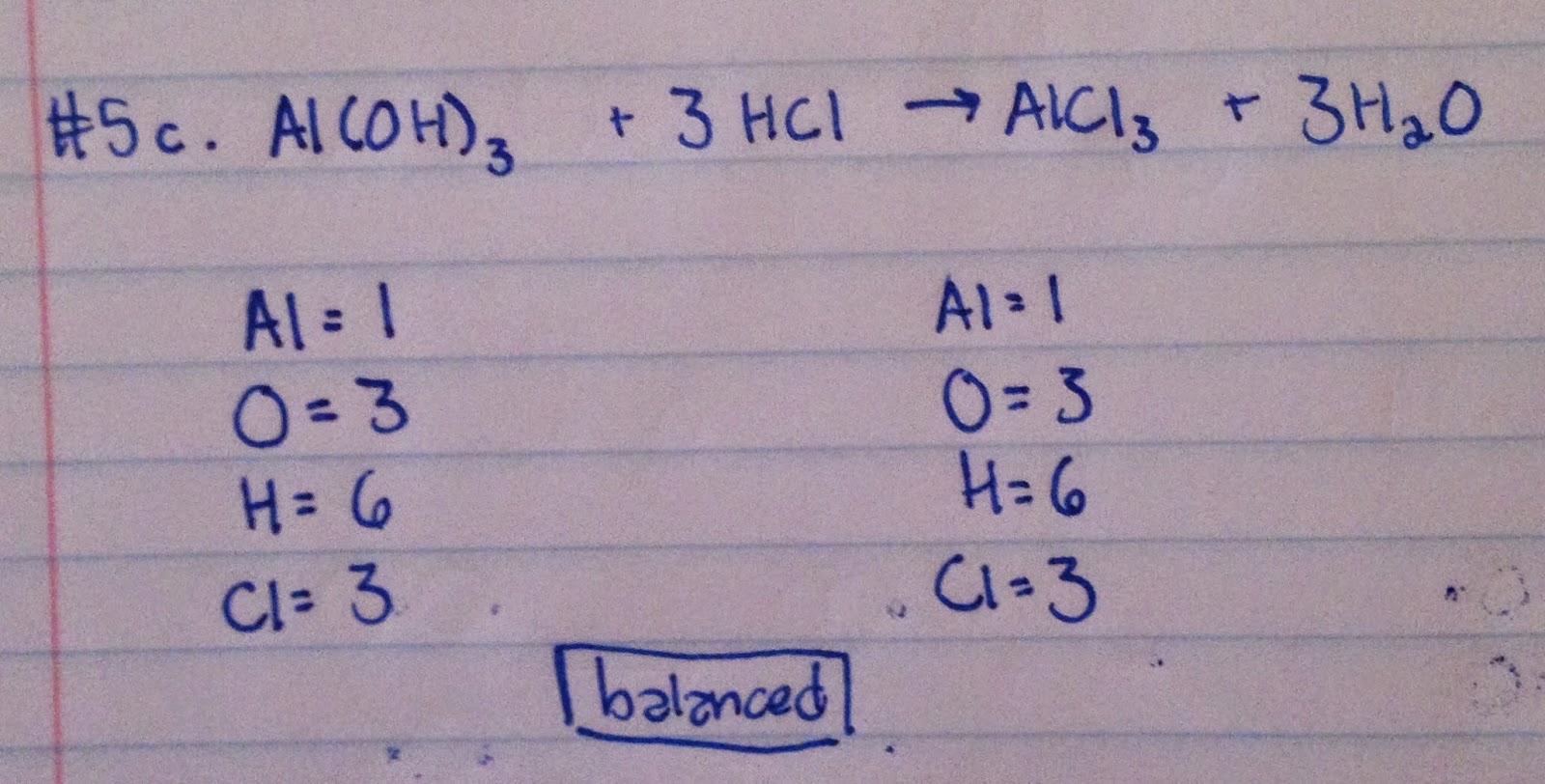
#5:
a. 

b.
c.

#1:
a. One molecule of methane combines with two molecules of oxygen to produce one molecule of carbon dioxide and two molecules of water. 
b.

c.

d.

#2:
a. One molecule of hydrobromic acid combines with magnesium to produce one molecule of hydrogen and one molecule of magnesium bromide.
b.
c.
d.

#3:
a.  Four molecules of silver, four molecules of hydrogen sulfide and one molecule of oxygen combine to produce two molecules of silver sulfide and four molecules of water.

b.
c.
d.

#4:
a.  One molecule of the ore hematite combines with three molecules of carbon oxide to produce two molecules of iron and three molecules of carbon dioxide.

b.
c.
d.

#5:
a.  Two molecules of aluminum combine with six molecules of hydrochloric acid to produce two molecules of aluminum chloride and three molecules of hydrogen.
b.
c.
d.

Monday, July 7, 2014

D.1, D.2, D.3, D.4


A diatomic molecule is a molecule that exists as two bonded atoms of the same elements.  Some examples include hydrogen, nitrogen, oxygen, fluorine, chlorine, bromine, and iodine.  When molecules of gasoline burn in an automobile engine, the carbon and hydrogen atoms react with oxygen in the air to form carbon monoxide, carbon dioxide, and water vapor.  This is all exhaust, and separate in the atmosphere.  The law of conservation of matter states that in a chemical reaction, matter is neither created nor destroyed.  This is why all chemical equations must have an equal number of atoms on both the reactant and product side.  This is called a balanced chemical equation.  A coefficient indicates the relative number of units of each substance involved in the chemical reaction.  

Wednesday, July 2, 2014

C. 11, C. 12, C. 13, C. 14, C. 15


Oxidization is when an element loses electrons.  Reduction, on the other hand, is when an element gains electrons. Electroplating is placing a thin layer of metal on a surface by an electrical process that involves oxidation-reduction reaction.  When oxidation and reduction occurs at the same time, it's called an oxidation-reduction reaction.  Dot structure is show electrons that are readily moveable as dots instead of a number.  A cathode is where reduction occurs, and an anode is the ultimate source of electrons in any electrochemical process.  A materials life cycle has multiple stages: its acquisition, manufacturing, use/reuse/maintenance, and recycle/waste management.  Energy is used in every stage, so it's important for scientists to think about how much energy is needed for each phase of life.  Waste is also produced, and the amount of waste must also be calculated.  

Unit 1 Section C Summary HW Problems Pt. 3


#21:
a.
i. 68.3%
ii. 10%
iii. 6.83%

#22:
The percent composition is determined by using an element's molar mass, not the amount of atoms of it in a compound.

#23:
Oxidation is losing (electrons), reduction is gaining (electrons)

#24:
a. Au2+ + 2e- --> Au
b. V - 4e- --> V4+
c. Cu+ - e- --> Cu2+

#25:
a. Reduction
b. Oxidation
c. Reduction

#26:
a. Zinc because it lost electrons
b. Nickel because it gained electrons
c.  Zinc

#27:
a. Mercury because it lost electrons
b. Potassium because it gained electrons
c. Mercury

#28:
a. Al + Cr3+ -->  Al3+ + Cr
b. Mn2+ + Mg --> Mn + Mg2+

#29:
a. Electrometallurgy uses an electric current to supply electrons to metal ions, reducing them
b. Pyrometallurgy treats metals and their ores with thermal heat
c. Hydrometallurgy treats ores and other metal-containing materials with reactant in water solution

#30:
a. Electrometallurgy
b. Pyrometallurgy

Tuesday, July 1, 2014

C.6, C.7, C.8, C.9, C.10

Moles are used by scientists to measuring weight.  Moles help us calculate the weight/mole of any element, giving us a number easier to wrap our head around rather than the actual weight of an atom.  Moles also help us determine percent composition, or how much of the a certain element is in a compound.  The equation to find the percent composition of an element is the weight/mole of the element over the weight/mole of the whole compound, multiplied by 100%.  When an ore is mined, manufacturers try and get the purity up to 100% through refining. Refining is the removal of impurities from the ores.  OIL RIG (Oxidation Is Loss, Reduction Is Gain) is an acronym to help you remember the rules of reduction and oxidation.  In metallurgy, there are three common ways to remove an ore from the crust of the Earth. First, electrometallurgy uses en electric current to supply electrons to metal ions, reducing them.  Then, pyrometallurgy treats metals and their ores with thermal heat.  Finally, hydrometallurgy treats metals and their ores with reactants in water solution.

Unit 1 Section C Summary HW Problems Pt. 2


#11:
The positive ions of the metals mix with the negative ions in nature, making them stick together.

#12:
a.  My main resource was the book
b. Our school textbook is most likely a reliable source
c. There wasn't any bias

#13:
I would consider our school textbook to be a reliable source, since it was a published work.

#14:
If your information is inaccurate, you will be lacking the actual information needed to maintain a safe lab environment.

#15:
19.1 million

#16:
a. 32 g/mol
b. 48 g/mol
c. 100 g/mol
d. 58 g/mol
e. 180 g/mol

#17:
Their molar masses aren't similar.

#18:
a. 1 mole
b. 1/2 of a mole
c. 1/10 of a mole

#19:
The quarter is 91.7% copper and 8.3 % nickel.

#20:
a. 87.1%
b. 53%
c. 40%

C.1, C.2, C.3, C.4, C.5


Resources such as copper are running low because the need for elements with useful traits such as ductility, conductivity, malleability, and resistance to corrosion is great.  Different resources come from different parts of Earth.  For example, the atmosphere gives us nitrogen, oxygen, neon, and argon.  The hydrosphere provides water and some dissolved minerals, and the lithosphere (or crust of the Earth) provides almost everything else.  The lithosphere has the greatest variety of chemical resources.  Manufacturers of theses raw materials may find a deposit of ores filled with minerals.  A deposit os a naturally occurring collection of ores in the lithosphere. Ores are naturally occurring rocks or minerals that can be mined.  Finally, minerals are naturally occurring solid compounds containing the element or group of elements of interest.  Miners and scientists have to consider a lot before they begin mining.  Some of the conditions that determine whether mining is a good idea are: quantity of the ore, percent of metal in the ore, type of mining and processing needed, distance from the mine to the manufacturing facility, the metal's supply-versus-demand status, and the environmental impact this process may have.  The percent composition of a component is the percent by mass of each component found in a sample.  To find the percent composition, one must divide the mass of each constituent metal by the mass of the whole and multiply by 100%.  Percent composition is important because it helps geologists describe the amount of a substance in an ore and helps weigh the decision on whether or not it should be mined.